8-bit CPU
Executes instructions from the PIC18 instruction set. It works with one-byte registers (0–255), such as WREG, STATUS, BSR, and the program counter.
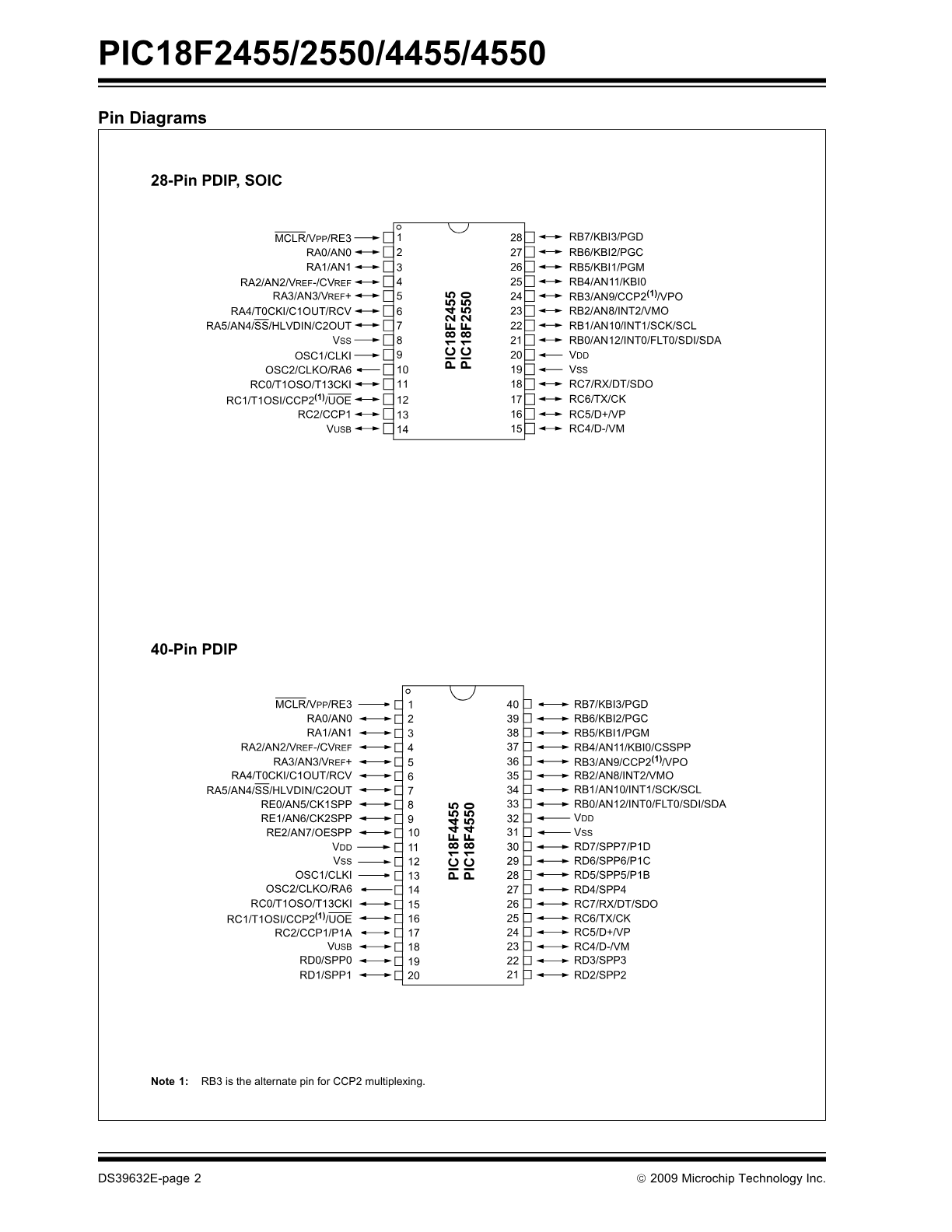
The PIC18F4550 is the 8-bit microcontroller you will use in this course. If you have not read basic microcontroller concepts (μC vs μP, memory, and peripherals) yet, start there.
It integrates CPU, Flash/RAM/EEPROM memory, I/O ports, and internal peripherals in a single chip. It is popular in courses because it forces you to understand the machine from the inside: registers, bits, ports, interrupts, and timers.
In digital systems, each bit is a position that holds 0 or 1. With n bits, the number of distinct combinations is 2ⁿ (two to the power of n).
| n (bits) | Combinations 2ⁿ | Numbers you can represent (unsigned) |
|---|---|---|
| 1 | 2 | 0 to 1 |
| 2 | 4 | 0 to 3 |
| 3 | 8 | 0 to 7 |
| 8 | 256 | 0 to 255 |
With 3 bits you get the combination table used in digital courses (each row is a distinct state):
| bit 2 | bit 1 | bit 0 | Decimal |
|---|---|---|---|
| 0 | 0 | 0 | 0 |
| 0 | 0 | 1 | 1 |
| 0 | 1 | 0 | 2 |
| 0 | 1 | 1 | 3 |
| 1 | 0 | 0 | 4 |
| 1 | 0 | 1 | 5 |
| 1 | 1 | 0 | 6 |
| 1 | 1 | 1 | 7 |
That is 8 rows = 2³ = 8 states, numbered 0 through 7.
The PIC18F4550 uses 8 bits per register (one byte). Same idea at scale: 2⁸ = 256 combinations, numbered 0 through 255. That is why WREG, PORTB, and most data registers fit in a single byte.
Each bit in the byte has a weight (power of 2). If the bit is 1, you add that weight:
| bit 7 | bit 6 | bit 5 | bit 4 | bit 3 | bit 2 | bit 1 | bit 0 |
|---|---|---|---|---|---|---|---|
| 128 | 64 | 32 | 16 | 8 | 4 | 2 | 1 |
Examples:
| Decimal | Binary (8 bits) | Calculation |
|---|---|---|
| 5 | 00000101 | 4 + 1 = 5 |
| 255 | 11111111 | 128 + 64 + 32 + 16 + 8 + 4 + 2 + 1 = 255 |
In Basic architecture you will see why a sum like 200 + 100 = 300 does not fit in 8 bits and sets carry flag C. In Bits and hexadecimal you go deeper into conversions and masks.
8-bit CPU
Executes instructions from the PIC18 instruction set. It works with one-byte registers (0–255), such as WREG, STATUS, BSR, and the program counter.
Flash memory
Stores the program. When you burn the .hex file, its content is stored here.
RAM
Stores temporary variables, counters, flags, and data while the program runs.
EEPROM
Non-volatile memory for data that must remain saved even when the circuit is powered off.
I/O ports
Pins configurable as digital inputs or outputs through registers like TRISx, PORTx, and LATx.
Peripherals
Timers, ADC, PWM, USART, USB, interrupts, and other internal modules.
Assembly lets you see what a high-level language usually hides. Instead of writing an abstract function, you directly modify registers and bits. This helps answer theory questions such as:
PORTB and LATB?TRISB before using it?The PIC18F4550 is a small dedicated computer where your program directly controls the hardware.
Based on: Tema 1. Conceptos Básicos (1).pdf
0 of 0 answered
Sign in with CALETAS to sync this result across devices.
Sign in with CALETAS