Interrupts
You already master GPIO and buttons with polling (BTFSS PORTB in a loop). Interrupts let the PIC jump to a service routine (ISR) when an event occurs — Timer0, keyboard, UART — without checking flags all the time. They are required in Practice 2 (keyboard), Practice 3 (frequency meter), and Practice 5 (timers + ISR).
You saw the base registers in Registers — interrupts. Here you complete Topic 6: vectors, enable chain, correct ISR, and link to Timer 0.
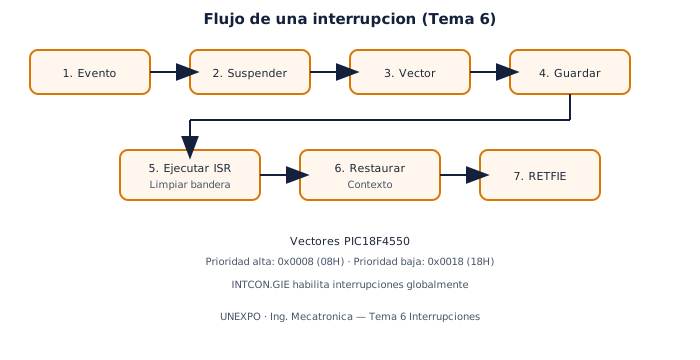
What an interrupt is
Section titled “What an interrupt is”An interrupt temporarily stops the main program to run urgent code. When done, the PIC returns exactly where it left off using the stack and RETFIE.
Step 1 — Polling vs interrupt
Section titled “Step 1 — Polling vs interrupt”| Approach | How it works | When to use |
|---|---|---|
| Polling | BTFSS TMR0IF / PORTB in infinite loop | Simple delays, one button |
| Interrupt | Hardware jumps to ISR when flag activates | Keyboard, precise timers, UART, frequency meter |
In Buttons, debounce with CALL retardo_20ms is polling. In Practice 2, the matrix keyboard uses RBIE so the CPU is not blocked scanning columns.
Step 2 — Three enable layers
Section titled “Step 2 — Three enable layers”For a peripheral ISR to run (e.g. Timer1), turn on three switches:
GIE = 1 ; global master (INTCON) ↓ PEIE = 1 ; peripherals (INTCON) — timers 1/2/3, UART, ADC… ↓ TMR1IE = 1 ; specific source (PIE1) ↓ Peripheral ready ; Timer1 running, overflow → TMR1IFTimer0 is special: TMR0IE and TMR0IF are in INTCON (not PIE1). For Timer0 you need GIE + TMR0IE; PEIE does not apply to Timer0 on PIC18.
Step 3 — Flag, vector, and ISR
Section titled “Step 3 — Flag, vector, and ISR”- The event sets a flag (
TMR0IF,RBIF,ADIF…) to 1. - If the source is enabled and GIE = 1, the CPU jumps to the interrupt vector.
- Your ISR handles the event, clears the flag, and runs RETFIE.
| Priority | Address | Assembly notation |
|---|---|---|
| High | 0x0008 | ORG 0x0008 or ORG 08H |
| Low | 0x0018 | ORG 0x0018 or ORG 18H |
In the course and datasheet you will see both forms: 0x0008 / 0x0018 (full hex) and 08H / 18H (short form used by MPASM in ORG). Both point to the same program memory address.
If you do not clear the flag, the PIC re-enters the ISR immediately.
Step 4 — Save context
Section titled “Step 4 — Save context”The ISR may use WREG, STATUS, and other registers the main program needed. Course minimum: save WREG and STATUS on entry and restore before RETFIE. Details in the practical guide — context.
Vectors in the .ASM — sandwich style
Section titled “Vectors in the .ASM — sandwich style”Vectors go at the top, after CONFIG and before main code:
        ORG     0x0000        GOTO    programa         ; reset → main
        ORG     0x0008            ; high priority (also: ORG 08H)        GOTO    isr_high         ; jump → high-priority vector
        ORG     0x0018            ; low priority (also: ORG 18H)        GOTO    isr_low          ; jump → low-priority vector
; ── Subroutines and ISRs ──────────────────────────────isr_high:        ; service high-priority sources        RETFIE
isr_low:        ; service low-priority sources        RETFIE
programa:        ; main code        END
In the lab, many practices use high priority only (ORG 0x0008 / ORG 08H) with all sources in isr_high.
Key registers
Section titled “Key registers”| Register | Function |
|---|---|
INTCON.GIE | Global enable — no interrupts without GIE |
INTCON.PEIE | Enables peripheral interrupts (Timer1/2/3, UART, ADC…) |
INTCON.TMR0IE / TMR0IF | Timer0 enable and flag |
INTCON.RBIE / RBIF | RB4–RB7 change interrupt |
PIE1, PIE2 | Enables each peripheral source (TMR1IE, ADIE…) |
PIR1, PIR2 | Event flags |
IPR1, IPR2 | High/low priority per source |
Summary chain — Timer0:
BCF INTCON, TMR0IF ; clear flag before start BSF INTCON, TMR0IE ; enable Timer0 interrupt BSF INTCON, GIE ; global master on BSF T0CON, TMR0ON ; start timerChain — Timer1 (peripheral):
BCF PIR1, TMR1IF BSF PIE1, TMR1IE BSF INTCON, PEIE BSF INTCON, GIEMain PIC18F4550 sources
Section titled “Main PIC18F4550 sources”| Source | Pin / module | Typical flag | Course use |
|---|---|---|---|
| INT0–INT2 | RB0, RB1, RB2 | INT0IF… | External button |
| RB port | RB4–RB7 | RBIF | Matrix keyboard — Practice 2 |
| Timer0 | Internal / RA4 | TMR0IF | Delay, blink — Timer 0 |
| Timer1/2/3 | Internal | TMR1IF, TMR2IF… | Frequency meter, PWM |
| CCP | RC2, etc. | CCP1IF | Capture, compare, PWM |
| ADC | ANx channels | ADIF | Analog read |
| USART | RC6/RC7 | RCIF, TXIF | Serial |
| USB | USB module | various | Advanced projects |
Minimal ISR — Timer0 with context
Section titled “Minimal ISR — Timer0 with context”Integrated example (vector + minimal save + reload):
        ORG     0x0008        GOTO    isr_high
isr_high:        BTFSS   INTCON, TMR0IF        GOTO    isr_done         ; not Timer0 → exit
        ; ── Save context (minimum) ──        MOVWF   temp_w           ; save WREG        SWAPF   STATUS, W        MOVWF   temp_status
        BCF     T0CON, TMR0ON    ; pause timer while reloading        BCF     INTCON, TMR0IF   ; clear flag        MOVLW   B'01100111'        MOVWF   TMR0H            ; reload precalculated value        MOVLW   B'01101010'        MOVWF   TMR0L        BSF     T0CON, TMR0ON
        ; ── Task: toggle LED ──        BTFSC   LATB, 0        GOTO    led_off        BSF     LATB, 0        GOTO    restoreled_off:        BCF     LATB, 0
restore:        SWAPF   temp_status, W        MOVWF   STATUS        MOVF    temp_w, Wisr_done:        RETFIE                   ; return and re-enable GIE
Timer setup: see Timer 0 — 2 seconds.
RB4–RB7 interrupt — keyboard preview
Section titled “RB4–RB7 interrupt — keyboard preview”For matrix keyboard (RB interrupt guide):
BCF INTCON2, RBPU ; internal PORTB pull-ups (per lab) BSF INTCON, RBIE ; enable RB4–RB7 change BSF INTCON, GIEIn the ISR: scan rows/columns, debounce, and clear RBIF by reading PORTB (PIC18 hardware requirement).
Common mistakes
Section titled “Common mistakes”| Mistake | Consequence |
|---|---|
| Forget GIE | ISR never runs |
| Do not clear TMR0IF / RBIF | Infinite ISR re-entry |
RETFIE without restoring WREG/STATUS | Corrupted main program |
| ISR too long | Missed events, timer jitter |
| Confuse polling with interrupt | CPU at 100% in empty loop |
Next step
Section titled “Next step”- Practical guide — Interrupts — step by step in MPLAB/Proteus
- Timer 0 — formula, T0CON, precise delay
- Practice 5 — Timers and interrupts — integrated lab
Exam-style questions
Section titled “Exam-style questions”What does INTCON.GIE do?
Enables or disables all interrupts globally. Without GIE = 1, no ISR runs.
Why clear TMR0IF before RETFIE?
If the flag stays 1, hardware considers the event still pending and re-enters the ISR.
Where are TMR0IE and TMR0IF?
In register INTCON, not PIE1/PIR1.
What does RETFIE do?
Returns from interrupt, restores PC from the stack, and re-enables GIE automatically.
Ejercicio · Parcial
Design the chain
List the registers you must set to 1 for Timer1 to generate an interrupt: GIE? PEIE? TMR1IE? TMR1ON?
Interrupts
Based on: Clase Tema 6. Interrupciones.pdf
0 of 0 answered
Sign in with CALETAS to sync this result across devices.
Sign in with CALETAS